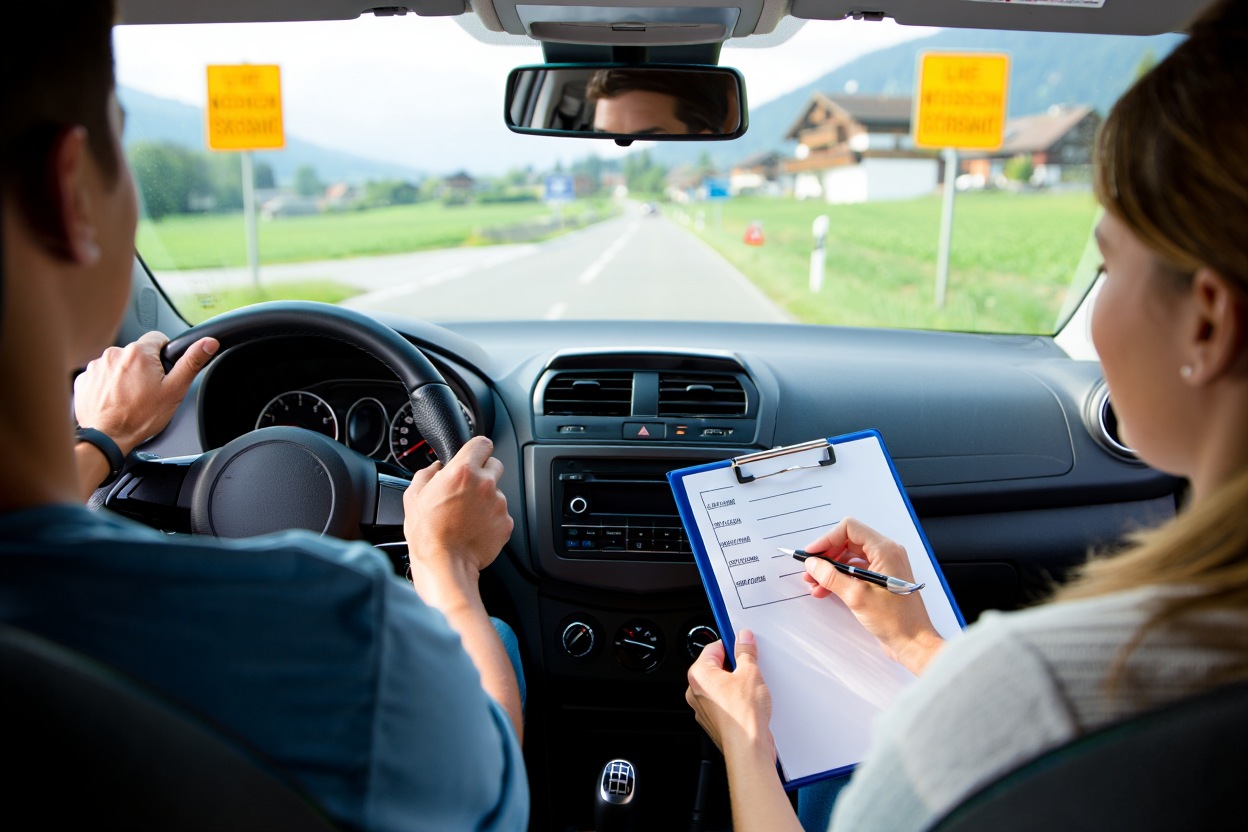
Vehicle accepted for the Swiss category B practical driving test
Technical condition, tyres, documents, minimum speed and checklist: what to verify before the Swiss category B practical test.
Editorial AZUL Auto-École®

Vehicle accepted for the Swiss category B practical driving test
Passing the practical driving test is a major step toward obtaining your Swiss driving licence. Many candidates focus only on their driving, but the vehicle used on test day must also meet precise technical and administrative requirements.
If the car does not meet those requirements, the test can be cancelled or postponed, causing stress, lost time and extra costs.
Category
B
Cars up to 3,500 kg
Speed
120 km/h
Minimum capability expected for assessment
Tyres
1.6 mm
Minimum legal tread depth
What is category B?
Category B is the standard Swiss car licence. It allows you to drive motor vehicles up to 3,500 kg with no more than eight passenger seats in addition to the driver.
Before the practical test, candidates must pass the theory test, obtain a learner permit, complete the compulsory courses and gain enough practical driving experience.
Why is the choice of vehicle important?
The examiner must assess your driving in a vehicle that is safe, road legal and suitable for all test situations. An obvious technical issue can lead to the test being refused before it even starts.
Cantonal authorities such as the OCN therefore apply clear rules for vehicles admitted to the practical test.
Main requirements for the vehicle

1. The vehicle must be in perfect technical condition
Brakes, lights, indicators, wipers and mirrors must work correctly. A visible defect can be enough to stop the test.
2. Tyres must be compliant

Tyres must be in good condition, appropriate for the season and have a minimum tread depth of 1.6 mm.
3. The vehicle must be fast enough
The car should be able to reach at least 120 km/h so the examiner can assess driving on main roads and motorways.
4. The vehicle must be authorised for road use
The car must be registered, insured and accompanied by valid vehicle documents.
Can you use any car?
You may use your instructor's vehicle, your own car, a family car or a borrowed car, provided it meets all technical and administrative requirements.
Most candidates use the driving-school car because it is already compliant, set up for training and familiar to the learner.
It is also possible to take the test in an automatic car. In Switzerland, passing in an automatic car now allows you to drive both automatic and manual vehicles.
Documents to bring

Required documents
- Your learner driving permit
- The vehicle registration document
- An identity document
How does the practical test work?

The practical test usually lasts around 45 to 60 minutes. The examiner observes traffic rules, vehicle control, observation, anticipation and independent decision-making.
You may be asked to park, turn around, drive in town or use faster roads. The goal is to confirm that you can drive safely and independently.
Vehicle mistakes to avoid
Avoid arriving with a dirty or poorly maintained vehicle, missing documents, technical faults or tyres that are too worn.
Pre-test checklist
- ✔ Check tyre pressure
- ✔ Test lights and indicators
- ✔ Check wipers
- ✔ Clean the windscreen
- ✔ Make sure all documents are present
Conclusion
The vehicle used for the category B practical test must meet technical and administrative requirements. A compliant, well-prepared car helps you avoid last-minute problems on test day.
Need a compliant vehicle and structured preparation? Book a lesson with AZUL or contact us.

FAQ
Can I take the test in my own car?
Yes, if the vehicle meets all technical and administrative requirements.
Can I take the test in an automatic car?
Yes. In Switzerland, passing in an automatic car now allows you to drive manual cars too.
What happens if the vehicle is not compliant?
The test may be cancelled and postponed to a later date.
Prepare your practical test with AZUL
A compliant vehicle, personalised lessons and real category B test preparation.